English
 English
 Deutsch
 Español
 عربي
عربي हिंदी
हिंदी

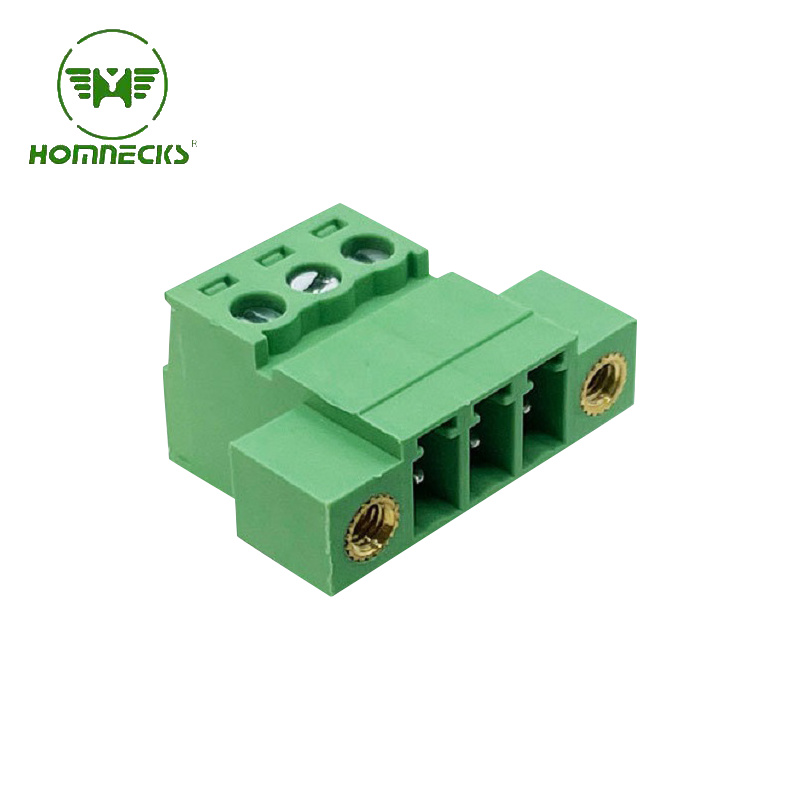
90-degree PCB plug connectors are widely used in control cabinets, automation devices, and compact PCB modules. Their right-angle design saves cabinet space and standardizes internal wiring layouts.
Most design and procurement engineers focus only on pin pitch, current rating, and mounting type. Few pay enough attention to plug housing materials.
From field troubleshooting experience, material defects cause most long-term plug failures. These include thermal deformation, dimensional loosening, poor insulation, and brittle cracking under vibration.
The housing material directly determines heat resistance, mechanical stability, moisture adaptability, and service life. Choosing the wrong material leads to intermittent connection faults, reflow soldering failure, and high after-sales rates.
This guide breaks down the four most common materials for 90-degree PCB plugs. It includes verified parameter comparisons, field pros and cons, and clear selection rules for industrial control projects.
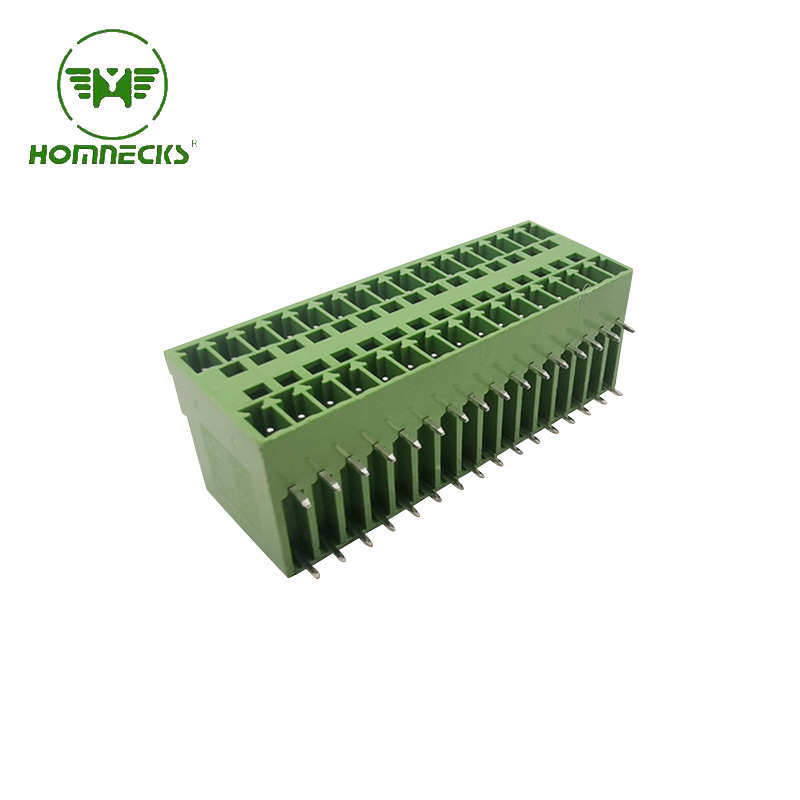
Right-angle PCB plugs face unique working stress compared with straight plugs.
The 90-degree structure bears repeated wire pulling and lateral vibration. The bending corner accumulates heat during high-current operation. SMT and wave soldering processes also bring instant high-temperature impact.
Low-grade materials deform easily after soldering. They cause pin misalignment and poor mating. In humid and dusty industrial workshops, unqualified materials lose insulation performance faster, bringing hidden short-circuit risks.
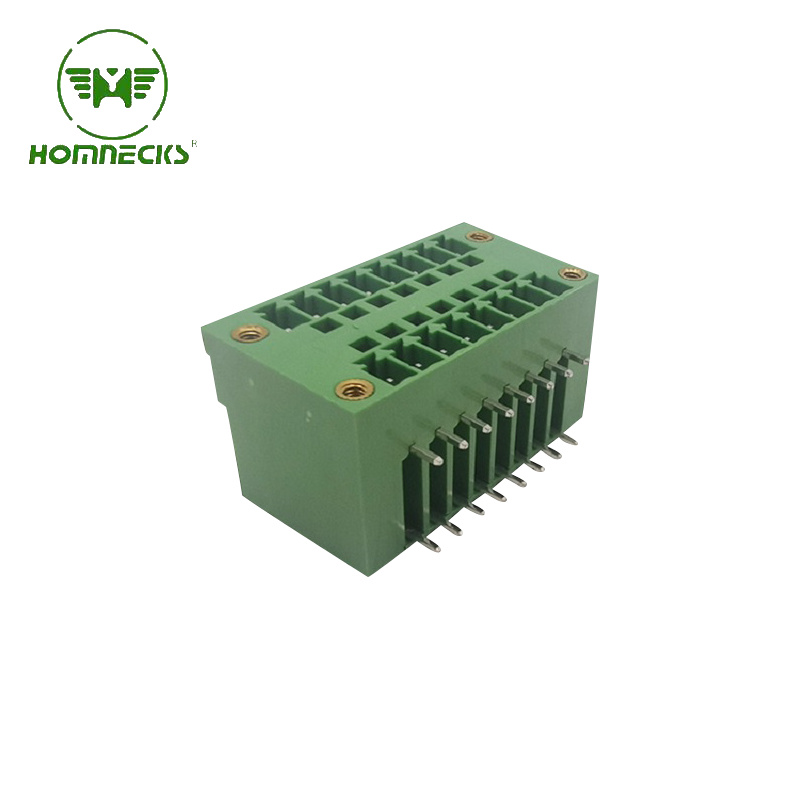
PA66, PBT, LCP, and PA9T dominate industrial 90-degree PCB plug manufacturing. The table below compares core industrial parameters based on actual soldering processes and field operation data.
| Performance Parameter | PA66 (Nylon 66) | PBT | LCP | PA9T |
|---|---|---|---|---|
| Continuous Working Temperature | -40°C to 105°C | -40°C to 120°C | -55°C to 240°C | -40°C to 150°C |
| Reflow Soldering Resistance | Max 230°C, easy softening | 240°C stable, slight shrinkage | 260°C+ fully compliant | 250°C high stability |
| Moisture Absorption Rate | 1.0%–3.0% (high, easy deformation) | ≤0.1% (ultra-low) | ≤0.02% (negligible) | ≤0.3% (low) |
| Vibration & Impact Resistance | Excellent toughness, anti-crack | Good rigidity, slightly brittle | High rigidity, anti-deformation | Balanced toughness & rigidity |
| Flame Retardant Grade | UL94 V-0 (standard) | UL94 V-0 | UL94 V-0 high grade | UL94 V-0 |
| Relative Material Cost | Low | Medium | High | Medium-High |
| Best Industrial Application | Wave solder, low-cost signal plugs | General industrial & automotive connectors | SMT high-temperature precision plugs | High-reliability power & signal plugs |
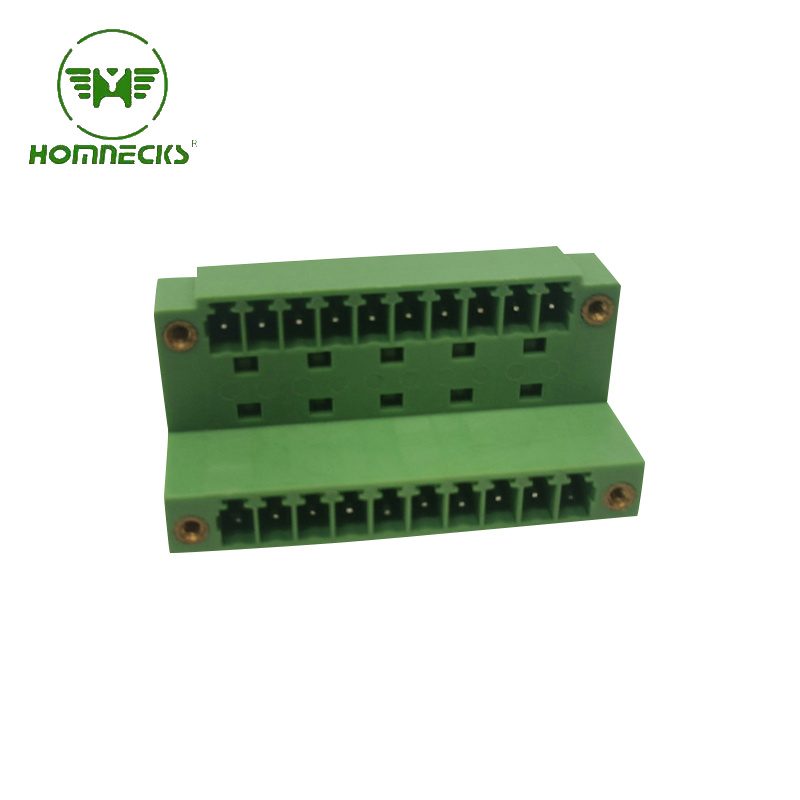
This simplified table helps engineers and purchasers quickly screen materials during BOM confirmation, avoiding over-specification or insufficient performance.
| Material | Key Field Pros | Key Field Cons |
|---|---|---|
| PA66 | Low procurement cost, strong toughness, resistant to impact and bending, widely available for mass production | High moisture absorption causes dimensional shift in humid environments; poor high-temperature resistance for SMT reflow processes |
| PBT | Ultra-low water absorption, stable size, good chemical and UV resistance, balanced cost and performance | Slightly brittle under strong vibration; easy to crack after long-term repeated plugging |
| LCP | Extreme high-temperature resistance, zero deformation after reflow soldering, ultra-stable insulation, best precision retention | High material cost, strict molding process requirements, not cost-effective for ordinary low-power circuits |
| PA9T | High heat resistance, low moisture absorption, excellent vibration resistance, stable for both power and signal circuits | Higher price than PA66 and PBT, mainly used for mid-to-high-end industrial equipment |
For wave soldering mass production, PA66 and PBT are fully qualified. They balance cost and basic heat resistance.
For SMT reflow soldering with 260°C high-temperature impact, only LCP and PA9T can avoid housing deformation and pin offset. PA66 will soften and cause assembly failure.
Humid workshop environments avoid pure PA66. Its high water absorption changes plug size, leading to loose mating and poor contact.
Vibration-prone equipment such as motor control cabinets prioritizes PA66 or PA9T. Their toughness prevents shell cracking.
High-temperature industrial cabinets choose PBT, PA9T or LCP to resist thermal aging.
Ordinary low-current signal circuits use PA66 or PBT for cost control.
High-current power circuits and high-precision signal acquisition circuits require PA9T or LCP. Stable insulation and size consistency avoid drift faults.
Most deformation issues come from mismatched housing materials. Standard PA66 cannot withstand 260°C reflow temperature. It softens and shrinks after heating, causing pin misalignment and poor mating. For SMT processes, always specify LCP or PA9T materials to ensure zero deformation after soldering.
PBT is the best balanced option for most conventional projects. It features ultra-low moisture absorption, stable dimensional performance, and qualified heat resistance. It avoids PA66’s humid-environment deformation risks and does not require the high budget of LCP materials, perfectly fitting mass-produced control cabinet signal and low-power circuits.
No. LCP is mandatory only for ultra-high-temperature reflow soldering and high-precision equipment requiring strict dimensional stability. For regular high-temperature working scenarios below 150°C, PA9T provides sufficient heat resistance and vibration resistance at a lower cost. Engineers can match materials according to actual process and environmental requirements to avoid over-specification waste.
 Contact Us
Signup our newsletter to get update information, promotion and insight.



 IPv6 network supported