In modern manufacturing and control cabinet production, wiring efficiency directly impacts project lead time and on-site delivery. Traditional screw-type terminal blocks rely on manual screw tightening for every wire connection. For complex PCB layouts and large control panels, this repetitive work consumes massive labor hours and slows down overall assembly progress.
Screwless terminal blocks have solved this industry pain point perfectly. Powered by precision spring tension technology, they cut down on-site wiring time significantly. More importantly, they deliver far better vibration resistance and long-term connection stability compared with conventional screw terminals, making them a future-oriented wiring solution for industrial equipment.
How Do Screwless Terminal Blocks Work?
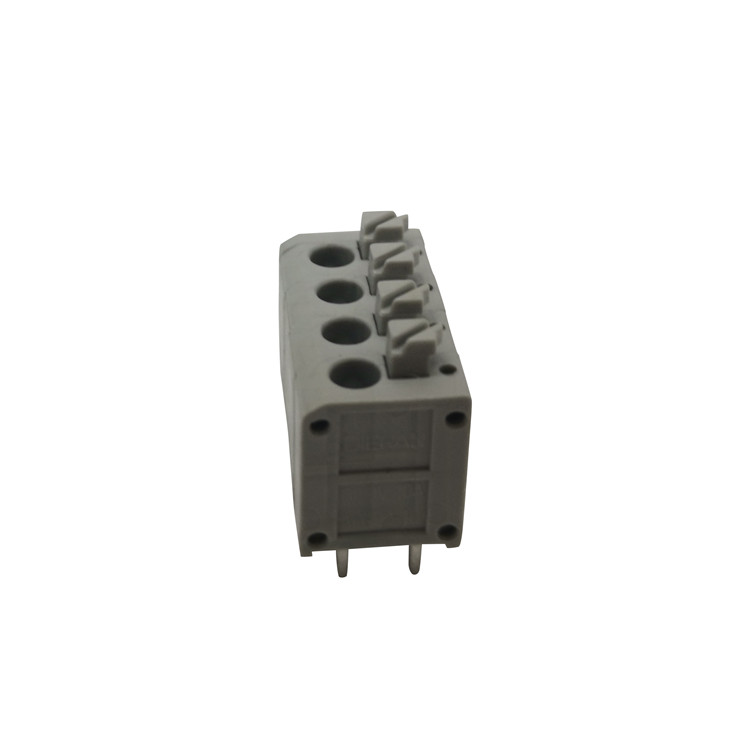
Screwless terminal blocks, also known as spring terminal blocks or push-in terminal blocks, eliminate the traditional screw fastening structure entirely. They adopt high-strength stainless steel spring components as the core clamping structure.
During on-site wiring, operators only need to insert stripped wires into the terminal holes. The built-in spring will automatically apply stable, constant pressure to lock the wire tightly against the conductive strip. This realizes fast, tool-free wiring and creates a reliable conductive connection.
Why Upgrade to Screwless Wiring Technology?
Most cabinet manufacturers and equipment engineers switch to screwless terminals for three core practical benefits, which address the most common pain points of traditional wiring:
1. Dramatically Faster On-Site Assembly
Speed is the biggest advantage of push-in screwless terminals. Traditional screw terminals require aligning wires, tightening screws, and checking fastening tension one by one — a tedious process for mass production.
Screwless terminals support direct wire pushing without any tools. Field test data from our assembly teams shows this solution reduces wiring time by up to 50%. It greatly improves production efficiency for batch control cabinet assembly and equipment wiring work.
2. Zero Maintenance Long-Term Reliability
Loose wiring is one of the most common on-site equipment faults. Screw-type terminals are prone to loosening under long-term equipment vibration and alternating temperature changes. Loose contacts will cause heating, poor conduction, and even unexpected equipment shutdowns.
The spring structure of screwless terminals provides continuous dynamic clamping force. The tension stays stable all year round, no matter in high-frequency vibration environments or temperature fluctuation scenarios. Engineers do not need to re-tighten terminals during regular equipment maintenance, saving long-term after-sales labor costs.
3. Ultra-Compact Design for High-Density Layout
Screw terminals require reserved space for screw heads and tool operation, which limits PCB layout density. SMD screwless terminal blocks remove bulky screw structures completely. They feature an ultra-low profile and ultra-small footprint.
This compact design is ideal for high-density PCBs, mini control devices, and LED lighting equipment with limited internal space, helping designers optimize cabinet and product structure layout.
Screwless vs Screw Terminal Blocks: Core Performance Comparison
To help engineers quickly select the right terminal blocks for project design, we sorted out a practical on-site performance comparison of the two mainstream wiring solutions:
Comparison Item
Screwless Terminal Blocks
Traditional Screw Terminal Blocks
Wiring Speed
Fast, tool-free push-in installation, 50% time saved
Slow, requires manual screw tightening for each wire
Vibration Resistance
Excellent, constant spring tension prevents loosening
Poor, screws loosen easily under long-term vibration
Subsequent Maintenance
Zero maintenance, no re-tightening required
Regular inspection and re-tightening necessary
Space Occupancy
Ultra-compact, suitable for high-density layout
Large space occupation, limited miniaturization
Service Life Stability
Long-term stable clamping force, low failure rate
Prone to aging and loose contact after long-term use
Typical Application Scenarios
Thanks to efficient wiring and stable anti-vibration performance, screwless terminal blocks have become the standard preferred solution for multiple industries:
- LED Lighting: LED drivers, modular lighting systems, and commercial lighting fixtures
- Smart Home Devices: Security alarm systems, smart thermostats, and IoT terminal equipment
- Telecommunication Equipment: Network routers, communication power supply modules, and signal transmission devices
- Vibration-Prone Machinery: Wind power equipment, elevator control systems, and rail transit electrical panels
Key Selection Guide for Screwless Terminal Blocks
When purchasing screwless PCB terminals for equipment projects, engineers can focus on three core indicators to avoid on-site wiring failures:
1. Operation Mode
Two mainstream types are available in the market: tool-operated and button-operated. Tool-type terminals need a flat screwdriver to pry open the spring for wire insertion and removal. Button-type terminals support fully tool-free wire release, offering more convenient on-site operation and higher maintenance efficiency.
2. Mounting Technology
Choose THT (Through-Hole Technology) terminals for traditional plug-in assembly processes. Select SMD (Surface Mount Technology) terminals for automated SMT production lines. Matching the mounting type with your production process can greatly improve assembly efficiency.
3. Wire Stripping Length
This is a detail easily ignored in on-site construction. Each screwless terminal has a standard stripping length. Strictly following the manufacturer’s recommended size ensures the spring clamps the wire core fully. Too short or too long stripping will cause poor contact or hidden safety hazards.
FAQ About Screwless Terminal Blocks
Q1: Are screwless terminal blocks safe in high-vibration environments?
Yes, they are safer and more stable than traditional screw terminals in vibration scenarios. The stainless steel spring provides continuous dynamic clamping force. It will not loosen with equipment vibration. In contrast, screw terminals will gradually lose tension over time, leading to loose connections and equipment faults.
Q2: Can stranded flexible wires be used for push-in screwless terminals?
Yes, but you need to follow standard construction specifications. For tool-free direct push-in installation, you must crimp a ferrule terminal on the stranded wire. If no ferrule is equipped, you need to press the release button or pry open the spring with a tool before inserting the bare stranded wire to ensure a firm connection.
Q3: Are screwless terminal blocks reusable?
Absolutely reusable. You can release the spring mechanism via the integrated button or a small screwdriver to pull out the wires easily. The spring structure will not be damaged after repeated disassembly and wiring. It supports multiple rewiring and maintenance operations, reducing equipment upgrade and modification costs.
 English
 English
 Deutsch
 Español
 عربي
عربي हिंदी
हिंदी

 Contact Us



 IPv6 network supported