For industrial equipment and control cabinet wiring, safety and stable power transmission are always the top priorities.
On high-power equipment and complex wiring systems, ordinary terminal blocks often bring hidden safety risks. This is why most field engineers prefer barrier terminal blocks for heavy-duty projects.
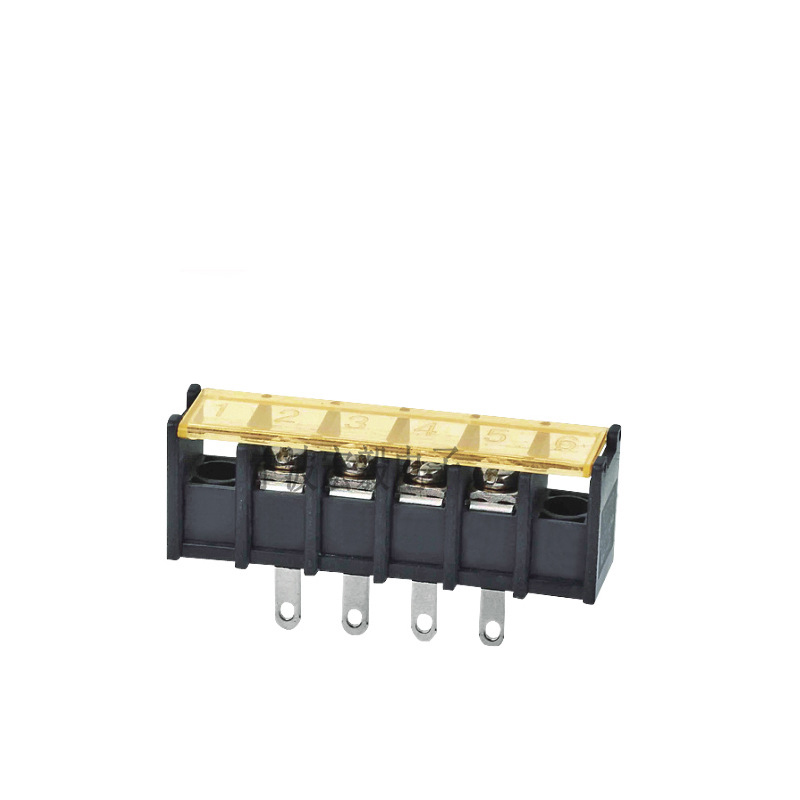
These terminals feature independent physical barrier walls between every wiring position. This simple but effective structure is specially designed for high-current scenarios. It greatly avoids short-circuit faults and improves the overall safety of equipment power circuits.
What Makes Barrier Terminal Blocks Different from Ordinary Terminals
Barrier terminal blocks are also known as American-style terminal strips. They adopt screw fastening connection methods. Every terminal point is separated by raised insulating barriers.
In actual on-site wiring, loose copper wire strands are very common during wire crimping and assembly. These tiny metal scraps easily touch adjacent terminals and cause short circuits after long-term equipment vibration.
The independent insulating barriers solve this practical problem perfectly. They physically isolate each circuit. This structure effectively cuts off the risk of cross-contact between wiring points.
Core Advantages of Barrier Terminal Blocks in Industrial Wiring
1. Higher Electrical Safety for Cabinet Wiring
The biggest advantage of PCB barrier terminal blocks is their integrated isolation barriers.
These barriers increase the creepage distance and electrical clearance between live parts. For high-voltage industrial equipment, sufficient insulation distance is essential. It keeps the circuit stable and safe during long-time operation, fully meeting industrial electrical safety standards.
In actual cabinet assembly, this design also reduces arc discharge and electric leakage risks caused by dense wiring.
2. Reliable High-Current Bearing Capacity
Miniature PCB connectors are only suitable for low-current signal transmission. They cannot bear long-term high-power load.
Barrier terminal blocks use thickened pure copper conductive contacts and reinforced screw structures. The contact is tight and stable. It does not loosen easily under continuous high current.
For industrial power lines and motor drive wiring, these terminals avoid overheating and burnout problems. They are the most practical choice for main power connection of mechanical equipment.
3. Tough Structure for Harsh Working Conditions
Most industrial control devices work in environments with vibration, dust and temperature changes.
Barrier terminal blocks are built with thick flame-retardant plastic shells and high-strength locking screws. The overall structure is sturdy and wear-resistant. It can adapt to long-term on-site use and repeated wiring maintenance.
Most models support optional transparent protective covers. In field application, this cover can prevent staff from accidentally touching live wires during debugging. It also blocks dust and metal debris from falling into the wiring gaps, extending the service life of terminal connections.
Common Industrial Application Scenarios
Barrier terminal blocks are widely used in equipment that requires high safety and stable power supply:
Power equipment: UPS uninterruptible power supply, switching power supply equipment
Industrial control: Heavy machinery control cabinets, motor driver equipment
Household electrical appliances: Large white household appliances that require stable mains connection
Transportation industry: Automotive power distribution panels, railway electrical control systems
How to Choose Suitable Barrier Terminal Blocks for Your Equipment
Engineers need to select terminals according to actual project design and cabinet layout. Here are the key selection points:
Single Row vs Double Row Terminals
Single-row barrier terminals save cabinet internal space with simple wiring. They fit equipment with fewer power circuits.
Double-row designs provide more wiring points in the same installation area. They are ideal for compact control cabinets with dense circuit requirements.
Rated Current Matching
This is the most critical selection standard. Always match the terminal rated current with the equipment’s actual maximum load current.
In actual engineering experience, do not run terminals at full load for a long time. Proper current margin can effectively prevent heating failure.
Installation Mode Selection
Choose PCB mount terminals if you need direct soldering on circuit boards.
Choose panel mount terminals for external cabinet wiring and on-site assembly wiring. Flexible installation types adapt to different equipment structural designs.
FAQ for Barrier Terminal Blocks
Q1: What is the function of the transparent cover of barrier terminal blocks?
A: The transparent protective cover is a very practical on-site accessory. It prevents accidental electric contact during equipment inspection and maintenance. Meanwhile, it isolates dust, iron filings and moisture in the workshop environment. It keeps the wiring terminals clean and ensures stable electrical performance for a long time.
Q2: Can barrier terminal blocks be used for signal wiring?
A: Although these terminals are mainly designed for power distribution circuits, they are also suitable for signal wiring in special working conditions.
For equipment with severe vibration or scenarios requiring strict circuit isolation, barrier terminals can avoid signal crosstalk and loose wiring. They provide more stable connection than ordinary signal terminals in harsh industrial environments.
Q3: Do you support customized barrier terminal blocks?
A: Yes, we are a professional terminal block manufacturer. We can customize terminal pole numbers, special mounting accessories and different pin pitches according to customer project requirements.
We support non-standard size modification and structural customization to perfectly match special control cabinet and equipment design needs.
Feature
Single-Row Barrier Terminal Blocks
Double-Row Barrier Terminal Blocks
Core Strength
Space-saving footprint, simple wiring layout
Higher connection density within limited PCB/panel space
Ideal Use Case
Designs with fewer connection points, tight linear layout
Multi-circuit power distribution where board space is constrained
Assembly Characteristics
Easier individual wire access during maintenance
Denser wiring, requires careful wire routing to avoid congestion
Cost Profile
Lower unit cost for low-channel configurations
Slightly higher cost, greater value for high I/O count designs
 English
 English
 Deutsch
 Español
 عربي
عربي हिंदी
हिंदी

 Contact Us



 IPv6 network supported