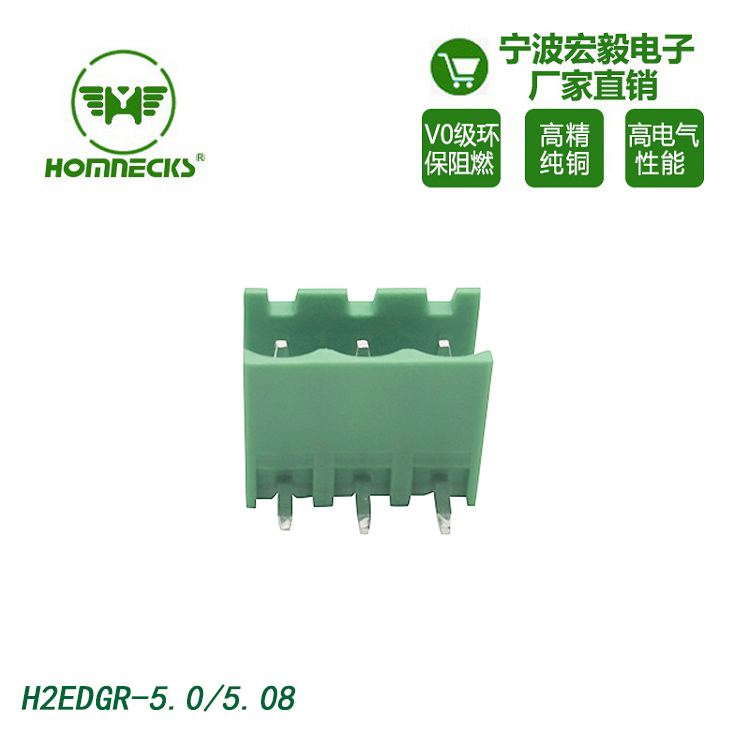
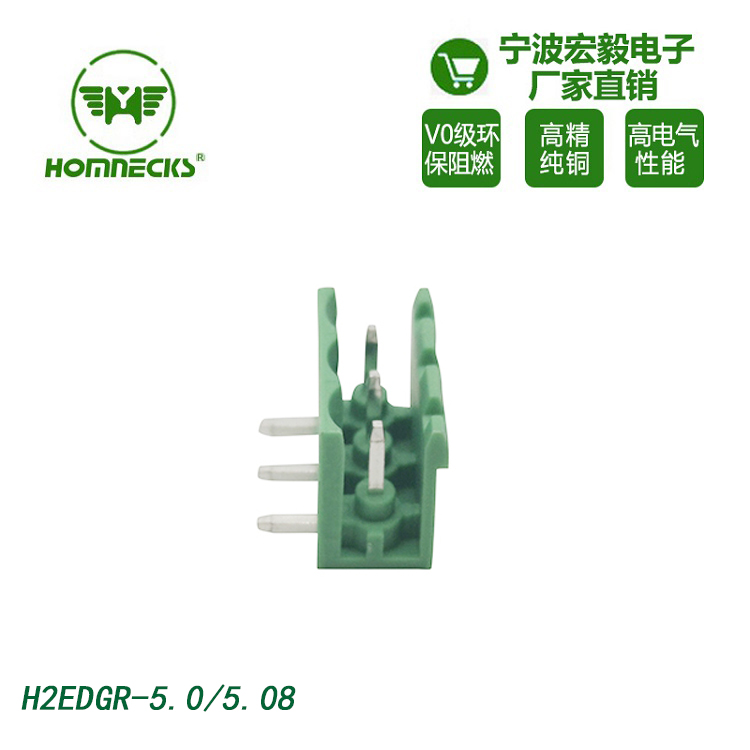
NingBo HongYi 5.08 Pcb Pluggable Terminal Block is a common electrical connection device with the following main features:
1. Rated voltage:NingBo HongYi 5.08 Pluggable Terminal Block usually have a certain rated voltage, usually in the range of 250V to 600V. This means that it can withstand voltages within the rated voltage range, terminal block 6 position ensuring the safe operation of the circuit.
2. Conducting resistance: NingBo HongYi 5.08 Pluggable Terminal Block is an indicator for evaluating their conductivity performance. A lower on resistance ensures that the current transmitted in the circuit can smoothly pass through the terminal connections, 6 position terminal block reducing current loss and heat.
3. Vibration resistance: NingBo HongYi 5.08 Pluggable Terminal Block should usually have a certain degree of vibration resistance, 6 pin terminal block connector which can maintain reliable electrical connections in vibration environments to prevent loosening or disconnection under vibration or impact conditions.
4. Rated current: NingBo HongYi 5.08 Pluggable Terminal Block usually have a certain rated current, usually in the range of 10A to 20A. This means that it can withstand current loads within the rated current range, 6 pin screw terminal ensuring that the circuit can operate normally.
5. Insulation resistance: The insulation resistance of plug-in terminals is an important indicator for evaluating their insulation performance. A higher insulation resistance means that plug-in terminals can effectively isolate the circuit during the connection process, 5 pin terminal connector preventing the occurrence of circuit short circuits and breakdown phenomena.
6. Temperature resistance: NingBo HongYi 5.08 Pluggable Terminal Block usually have certain temperature resistance and can work normally under a certain range of temperature conditions. This ensures that the terminals can adapt to different working environments and temperature changes.
These performance indicators are usually tested and evaluated according to relevant standards and specifications to ensure the reliability, safety, and performance of plug-in terminals meet the requirements. The specific performance parameters may vary depending on the manufacturer and product model, so when choosing to use 5 position terminal block, relevant technical specifications and certification documents should be referred to.
1.NingBo HongYi terminal block Shielded wire connection: In RS485 communication, in order to improve anti-interference performance,16 pin terminal block shielded wires are often needed to shield external electromagnetic interference. terminal block 16 pin Shielded wires are generally connected to the shielding ground terminal of RS485 controllers, pcb mount terminal can provide a reliable connection method to connect the shielded wires to the corresponding terminals, forming a good shielding effect.
2.NingBo HongYi terminal block Signal line connection: RS485 communication requires10 way connector block data transmission through two signal lines, namely A line and B line, also known as forward and reverse lines. Pcb mount screw terminal block connector provides a reliable connection method, 16 position terminal block connecting the A and B wires to the corresponding terminals of the RS485 controller. Screw type terminal blocks can fix signal wires and ensure the stability of electrical connections by adjusting screws.
The application of screw type terminal blocks in RS485 controllers makes signal line connections more convenient and reliable. Through them, stable signal transmission and anti-interference capabilities can be achieved, improving the reliability and performance of RS485 communication systems.
NingBo HongYi Double row PCB terminal block is a commonly used wiring connector on electronic devices and circuit boards, with double row slots that allow it to connect multiple wires. The following are some common electrical performance standards used to evaluate the performance and quality of 10 way terminal block:
NingBo HongYi Double row PCB terminal block Rated Voltage: This refers to the maximum voltage that 10 pin terminal block connector can withstand. Usually expressed in volts (V). The rated voltage should meet the voltage requirements of the connected circuit to ensure safe electrical insulation and reliable electrical connections.
NingBo HongYi Double row PCB terminal block Retention Force: This refers to the resistance of a wire or plug inserted into a terminal slot to detach from the terminal. A higher detachment force can ensure a stable connection and prevent loosening or detachment caused by vibration or external forces.
NingBo HongYi Double row PCB terminal block Rated Current: This refers to the maximum current value that 10 pole terminal block can withstand. Usually expressed in amperes (A). The rated current should be determined based on the design and material quality of the terminal block to ensure that it can safely transmit the current of the connected circuit.
NingBo HongYi Double row PCB terminal block Insulation Resistance: This refers to the insulation performance between 10 pin terminal block, that is, the ability of terminal blocks to be non-conductive under specific temperature and humidity conditions. Usually expressed in ohms (Ω). A higher insulation resistance means better insulation performance and is more reliable in avoiding circuit short circuits and faults.
NingBo HongYi Double row PCB terminal block Contact Resistance: This refers to the resistance connected internally within the 8 pin terminal connector. Lower on resistance means better electrical connection performance, reducing energy loss and signal attenuation.
These electrical performance standards are typically evaluated and validated through specifications and testing methods developed by relevant standard organizations such as the International Electrotechnical Commission. When selecting dual row PCB terminal blocks, these standards can be referenced to ensure that the selected 7 pin terminal block meet the requirements of the equipment and circuit, and provide reliable electrical connections.
The advantages Pluggable terminal block :a new choice for efficient, convenient, and flexible electrical connections
Pluggable terminal block have the advantages of fast installation, easy maintenance, high reliability, and wide application, making them an efficient, convenient, and flexible choice in the field of electrical connections.
As a new type of electrical connection method, plug-in terminals have been widely used in various fields in recent years. Its advantage lies in the ability to quickly achieve electrical connections and easy maintenance, making it the preferred choice for many electrical engineers and technicians. This article will provide a detailed analysis of the advantages of plug-in terminals, helping everyone better understand and use this electrical connection method.
1、 Widely used to meet different needs
screwless connector are suitable for various electrical connection scenarios, including industrial control, power transmission, communication, and other fields. They can meet the connection needs of different electrical equipment and provide diverse connection methods. In addition, plug-in terminals also have flexible customization, which can be customized according to specific needs to meet the personalized needs of different customers.
2、High reliability ensures safe and stable operation
In the design and manufacturing process of plug-in terminals, emphasis is placed on improving the reliability and stability of the connection. Screwless pcb terminal block usually have a high number of insertions and durability, and can withstand a certain degree of vibration and impact. In addition, plug-in terminals are made of high-quality materials and advanced production processes to ensure that the connecting parts have good conductivity and mechanical strength, thereby ensuring the safe and stable operation of electrical equipment.
3、Quick installation to improve work efficiency
Pcb terminal screw adopts a plug-in connection method, without the need for screws or other fasteners. Simply insert the wire into the terminal and press the locking mechanism to complete the connection. This installation method is simple and easy to implement, greatly improving work efficiency. Compared to traditional connection methods, plug-in terminals can save a lot of installation time, reduce labor intensity, and enable electrical engineers and technicians to focus more on other important tasks.
4、Easy to maintain and reduce failure rate
Pcb pluggable terminal block connector also have advantages in maintenance. Due to the use of plug-in connection, when electrical equipment needs to be replaced or repaired, simply unplug the terminals to complete the disassembly work. In addition, plug-in terminals usually have good sealing performance, which can effectively prevent pollutants such as dust and moisture from entering the connection part, thereby reducing the failure rate and improving the reliability of electrical equipment.
In Summary, pluggable pcb terminal blocks have demonstrated unique advantages in the field of electrical connections due to their high efficiency, convenience, and flexibility. They can quickly achieve electrical connections and improve work efficiency; Easy to maintain and reduce failure rate; High reliability ensures the safe and stable operation of electrical equipment; And it is widely applicable to various scenarios to meet different needs. Therefore, pluggable pcb terminal block have become an ideal choice for electrical engineers and technicians, injecting new vitality into the development of the electrical connection field.
NingBo HongYi Male and female plug terminals are electrical connecting components that are known for their convenient installation and high reliability. 5.08 pitch connector are widely used in the fields of electronics, communications, and automotive industries.NingBo HongYi Male and female plug terminals, as the name suggests, consist of male and female parts for electrical connections. 3.81 mm connector achieve circuit connections and disconnections through the mating of male and female parts, and are commonly used in electronics, communications, and automotive industries.
I.Features and Advantages of Male and Female Plug Terminals
1. Convenient installation: NingBo HongYi screwless electrical connectors adopt a plug-in design, making installation simple and quick without the need for special tools or skills.
2. High reliability: 3.81 connector are made of high-quality materials, ensuring excellent conductivity and insulation properties, thus guaranteeing stable and reliable circuit connections.In conclusion, NingBo HongYi screwless connector block are essential electrical components with easy installation and high reliability, suitable for various applications in electronics, communications, and automotive industries.
II.Structure and Working Principle of Male and Female Plug TerminalsNingBo HongYi Male and female plug terminals typically consist of metal conductors, insulators, and fixing components. 3.5 mm terminal, usually made of copper or copper alloys, provide excellent conductivity. Insulators protect the metal conductors and prevent electrical leakage, often made of plastics or rubber materials. Fixing components secure the terminals on circuit boards or devices, ensuring stability of the connections.The working principle of male and female plug terminals is straight forward; when the male part is inserted into the female part, an electrical connection is established between the metal conductors, facilitating circuit connections. To disconnect the circuit, simply remove the male part from the female part.
Terminal blocks are widely used for connecting and transmitting signals to control and operate mechanical equipment. Here are some specific applications of 5.08 pitch connector in mechanical control systems:Motor control: 5.08 terminal block are used to connect motors and controllers to transmit motor control signals in electrical control circuits. By connecting the motor to the terminal 5.08, functions such as starting and stopping, forward and reverse rotation, and speed control can be achieved.Sensor connection: Mechanical control systems often use various sensors, such as pressure sensors, temperature sensors, and photoelectric sensors, to detect and monitor the status of mechanical equipment. pcb connector terminal block are used to connect these sensors and transmit sensor signals to the controller for processing and decision making.Switch control: Switches in mechanical equipment are used to control the starting, stopping, or switching of certain functions. Green screw terminal are used to connect control switches and controllers to transmit switch status signals, triggering corresponding operations or controls based on the switch status. Position sensor connection: Mechanical control systems often use position sensors, such as encoders or position limit switches, to detect and provide feedback on the position information of the equipment. Pcb screw terminal connector are used to connect position sensors and controllers to transmit position signals to the control system, enabling accurate position detection and control.Controller connection: Mechanical control systems typically use controllers (such as PLCs) to control and coordinate the entire system. Terminal blocks are used to connect the controller to the input and output interfaces of the equipment, transmitting control signals to various components effectively.If you are interested in exploring how terminal blocks can enhance the performance and efficiency of your mechanical control systems, please feel free to contact us for further information.
Terminal blocks have wide applications in the field of control signal transmission. Control signal transmission refers to the transfer of signals from a controller to an actuator or other control devices to control devices, systems, or processes. Terminal blocks play a crucial role in connecting and transmitting signals in control signal transmission. Here are some applications of terminal blocks in the field of control signal transmission:Automation equipment: pcb terminal block 2.54 mm are commonly used to connect sensors, actuators, and controllers in automation equipment. They provide reliable electrical connections to transmit control signals from the controller to the actuator, such as motors, valves, drivers, etc., to achieve control and monitoring of automated processes.PLC (Programmable Logic Controller) system: PLC systems are widely used in the industrial automation field, and terminal blocks are used to transmit control signals from the PLC to various input and output devices. These input and output devices can be sensors, actuators, motors, switches, relays, etc., and terminal blocks provide reliable electrical connections and signal transmission.Process control system: In industrial process control systems, terminal block 3 position are used to connect the controller and control devices, such as variable frequency drives, control valves, sensors, etc. They transmit control signals to monitor and control the process, adjust parameters, and ensure the stable operation of the process.Mechanical control system: pcb terminal block plug connect the controller and various actuators, such as cylinders, motors, sensors, in mechanical control systems. They transmit control signals to control the movement and operation of mechanical equipment.
Thank you for considering the application of terminal blocks in control signal transmission. If you have any further questions or would like to discuss how our terminal blocks can benefit your specific application, please feel free to contact us.We are professional pcb terminal block manufacturers and terminal block factory.
Terminal blocks are widely used in the lighting industry for various applications. The lighting industry involves a wide range of lighting devices and systems, and terminal blocks play a crucial role in providing connection and power supply. Here are some applications of terminal blocks in the lighting industry:1. Lighting device connection: Terminal blocks are used to connect lighting devices such as fixtures, bulbs, etc., to the power supply lines. They provide reliable electrical contact, ensuring stable power supply and normal operation.2. Lighting system wiring: Lighting systems often require wiring to connect different fixtures and controllers. Terminal blocks are used for wiring connections, providing reliable electrical connections between various fixtures and easy connections to power lines and control devices.3. Safety connections: Terminal blocks also play a vital role in ensuring safety connections in the lighting industry. They can secure the connection between power lines and fixtures, preventing circuit loosening or poor contact that can lead to faults and safety hazards.4. Control signal transmission: Some lighting systems require remote control and dimming. Terminal blocks are used to connect lighting controllers and dimming devices, transmitting control signals to adjust and control the lighting.5. Fixture maintenance and replacement: During fixture maintenance and replacement, terminal blocks provide a convenient way for disassembly and connection, allowing maintenance personnel to easily handle connections between wires and fixtures.By utilizing terminal blocks, it ensures stable power supply and reliable connections for lighting devices, providing safety and convenience. Terminal blocks also simplify the installation and maintenance of lighting systems.
Terminal blocks have a wide range of applications in the field of instruments and meters. Instruments and meters are devices used for measuring, monitoring, and controlling various physical quantities and processes, and terminal blocks play an important role in connecting and transmitting signals in this field. Here are some common applications of terminal blocks in the field of instruments and meters:Signal connection: Instruments and meters need to be connected to sensors, actuators, controllers, and other devices to receive and transmit various signals. Terminal blocks are used to provide reliable electrical connections, ensuring stable signal transmission and accurate measurements.Instrument wiring: Terminal blocks are used for internal wiring in instruments, connecting control buttons, indicator lights, display screens, and other components on the instrument panel. This makes the use of instruments more convenient, and operation and monitoring more intuitive.Instrument calibration: Terminal blocks also play an important role in instrument calibration. By connecting calibration instruments and the instrument being calibrated through terminal blocks, signal transmission and calibration accuracy are ensured.Instrument maintenance: During instrument maintenance and repair, terminal blocks allow for easy disconnection and connection of various modules inside the instrument, providing a convenient way for maintenance and repair.Signal isolation: Some instruments require signal isolation to ensure the safety and accuracy of data. Terminal blocks can provide signal isolation and anti-interference functions, protecting the normal operation of instruments and systems.Through the application of terminal blocks, instruments and meters can achieve reliable signal connection and transmission, providing accurate measurement and control functions. Terminal blocks also simplify the installation and maintenance processes of instruments.
1. Screw terminals: These terminals use screws to clamp down on wires, providing a reliable connection and secure fastening. They are widely used in industrial control, power equipment, and automation devices.2. Spring terminals: Spring terminals use spring force to secure wires in place, allowing for quick insertion and removal. They are commonly found in household appliances, communication equipment, and instrumentation.3. Pierce terminals: Pierce terminals use sharp metal pins to pierce through the insulation of wires, creating a permanent connection. They are often used in power electronics and lighting equipment.4. Leaf terminals: Leaf terminals rely on the elastic deformation of metal leaves to secure wires, making them suitable for small electronic devices and automotive electronics.5. Socket terminals: Socket terminals provide a plug-and-play connection similar to sockets and plugs. They are commonly used in electronic products and computer equipment.6. IDC terminals: Insulation Displacement Connectors use a method of piercing through insulation to make contact with the metal terminal, making them suitable for high volume production and high-density wiring applications.These are just a few examples of the types of PCB terminal blocks available in the market. Depending on your specific requirements and project needs, the right type of terminal block can be selected for optimal performance.
Printed Circuit Board (PCB) terminal blocks play a crucial role in electronic devices by connecting circuits, transmitting signals, and supplying power. Here are the main functions of PCB terminal blocks:1. Circuit connection: PCB terminal blocks are used to connect different circuits on the circuit board, such as power lines, signal lines, and ground lines. They provide a reliable connection point to ensure the continuity of the circuit.2. Signal transmission: PCB terminal blocks can transmit various signals, including analog and digital signals. By correctly connecting and fixing signal lines, electronic devices' signals can be effectively transmitted.3. Power supply: PCB terminal blocks can be used to supply power, such as connecting batteries or external power adapters. They provide a safe connection point to ensure that power is correctly delivered to the various components on the circuit board.4. Replaceability: PCB terminal blocks typically have a plug-and-play function, allowing for easy replacement or debugging of electronic components. This design simplifies maintenance and replacement, improving the device's maintainability.In summary, PCB terminal blocks play a crucial role in the design and manufacturing of electronic devices, ensuring stable and reliable connections between components on the circuit board, and enabling signal transmission and power supply. They are widely used in computer, communication equipment, household appliances, industrial automation, and other fields.If you have any further questions or require more information, please do not hesitate to contact us.
1. Automation control systems: Terminal blocks are used to connect sensors, actuators, and controllers to facilitate the transmission of signals and power.2. Power distribution systems: Terminal blocks are employed to connect cables and wires for supplying power to different equipment, machinery, and power networks.3. Transportation equipment: Terminal blocks are utilized to connect motors, lighting devices, and electronic systems in vehicles such as cars, trains, and ships.4. Electronics and instrumentation: Terminal blocks are used to connect wires and cables on circuit boards and control panels.5. Construction and engineering sectors: Terminal blocks are applied to connect lighting systems, safety systems, and electrical equipment.These are some common examples of the applications of pluggable terminal blocks, and they are extensively used in numerous industrial fields to fulfill the electrical connection requirements of terminal equipment.Should you have further inquiries or require more information on our pluggable terminal block products, please do not hesitate to contact us.